Research

Current and Past Projects

Conducted at Lamont-Doherty Earth Observatory of Columbia University, Palisades, NY.

01

Evaluating the Impacts of Model Choice on Assessment of Surface Ocean pCO2 Reconstruction Skill in Climate Model Testbeds

Lab · McKinley Ocean Carbon Group, LDEO PI & Mentor · Galen A. McKinley Collaborators · Thea H. Heimdal, Amanda R. Fay International Collaboration · Surface Ocean CO2 Mapping (SOCOM) Program Spring 2026 – present
Senior thesis First-author manuscript in preparation AGU 2026 Oral Presentation Comer Climate Fellowship Python

The ocean absorbed roughly 29% of anthropogenic CO2 emissions over the past decade. Quantifying that sink from sparse measurements relies on observation-based data products, which are validated against Global Ocean Biogeochemical Models and Earth System Models used as testbed truths: the data product is given only the coverage of real observations, then asked to reconstruct the model's full pCO2 field.

Whether it matters which models serve as the testbed had not been tested. This project assesses 7 data products by ensemble-averaging according to testbed model choice, using 5 GOBMs over 2001–2021 and 6 triple-member ESMs over 1982–2023.

My role

I built and ran the analysis in Python. For every data product I computed bias, unbiased RMSE, and correlation against its testbed at regional, basin, and global scales, then applied the same metrics to each testbed model against independent observations from GLODAP, SOCAT, and the LDEO pCO2 database — and evaluated all 31 possible ensemble combinations of the five GOBMs.

The results show that ranking testbed models by their skill against observations has only a minor effect on assessed reconstruction skill, and that ensemble-averaging generally improves it. The equatorial and Southern Ocean subtropical biomes are the exception: there, including certain testbeds can marginally worsen ensemble-averaged skill, but never improve it. This work is my senior thesis and a first-author manuscript in preparation.
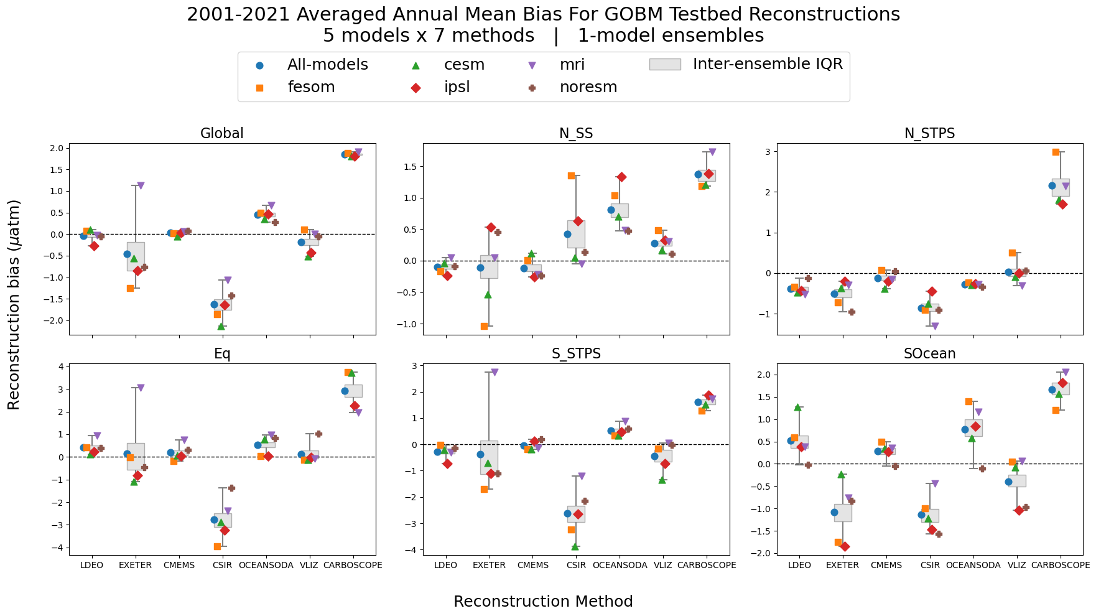
Reconstruction bias across seven methods for one-model testbed ensembles, by biome
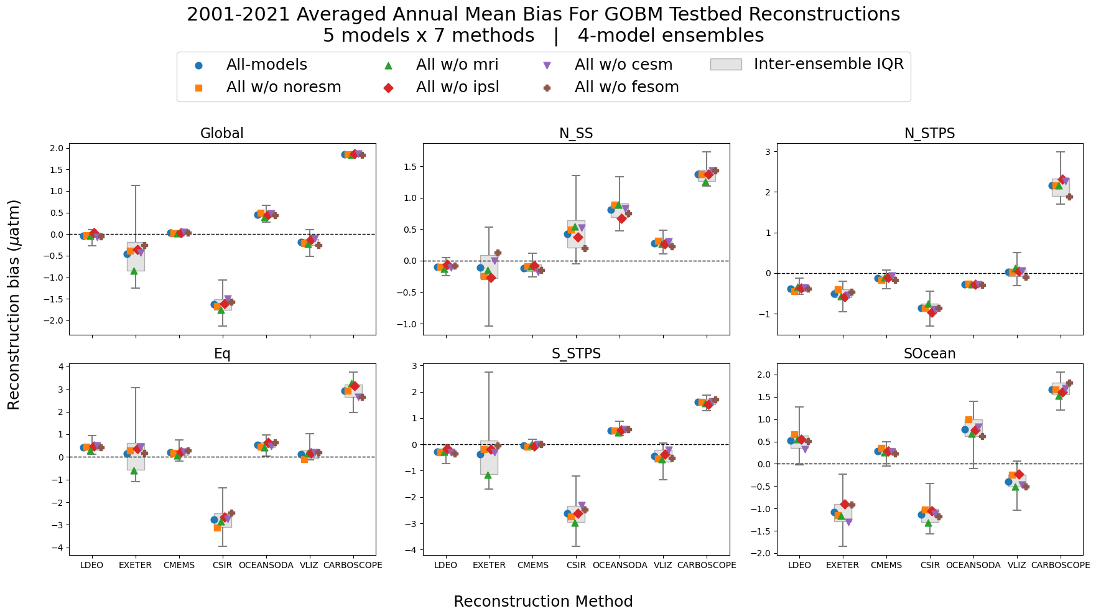
Reconstruction bias across seven methods for four-model testbed ensembles, by biome
Area-weighted 2001–2021 averaged annual mean bias of reconstructed global-field surface pCO2 against various GOBM testbed ensemble choices, for single-model (left) and four-model (right) ensembles. Datasets are collapsed to time series and area-weighted to calculate bias. Grey boxes show the inter-ensemble spread: the interquartile range of the 2001–2021 average taken over all 31 possible ensemble combinations (1 to 5 members), with whiskers showing max–min. Truths are masked with 100 and 1000 µatm cutoffs; cutoffs are not applied to the reconstructions. Subplots show different superbiomes. Click either figure to enlarge

Materials

Read the AGU 2026 abstract

Over the past decade, the ocean carbon sink absorbed 29% of total anthropogenic CO2 emissions. To quantify this sink from sparse observations, Global Ocean Biogeochemical Models (GOBMs) and Earth System Models (ESMs) simulate the global ocean carbon cycle, typically at 1-by-1-degree horizontal resolution. Recent assessments of observation-based ocean carbon data products use GOBMs and ESMs as “testbed” truths: data products sample the testbeds at the spatio-temporal coverage of independent observations, then reconstruct surface ocean pCO2 using statistical and machine learning techniques. The testbed approach then allows for a comprehensive assessment of the data product’s ability to reconstruct the full field in the context of sparse pCO2 data coverage. It has not been studied whether differences in the testbed model skill in representing real-world mean and seasonality of pCO2 may impact testbed results. Thus, this study assesses the data products by ensemble-averaging based on their testbed model choice. We use 5 GOBMs over 2001–2021 and 18 ESM members over 1982–2023. Considering regional, basin, and global scales, the bias, unbiased RMSE, and correlation are calculated of each data product against its testbed. Likewise, the same metrics are computed for each testbed model against real-world independent data from GLODAP, SOCAT, and LDEO pCO2 databases. Results show that sorting the testbed models based on their skill against observations has a minor impact on the assessment of reconstruction skill across 7 data products. Echoing published findings, ensemble-averaging generally improves global and regional reconstruction skill compared to using single-member testbeds. Nonetheless, the equatorial and Southern Ocean subtropical biomes show greater sensitivity to testbed choice, where including certain testbeds can marginally worsen, but not improve, ensemble-averaged skill. This study highlights the versatility of testbeds and endorses the use of ensemble-averaging in multi-model testbed experiments, since specific testbed model choices can harm regional reconstruction skills, especially in observation-scarce and biogeochemically complex biomes.

AGU 2026 Annual Meeting, San Francisco · Session A072 — From Physics to AI: Benchmarking, Bias Diagnosis, and Process Representation in Earth System Models.
Anna Chen, Galen A. McKinley, Thea Hatlen Heimdal, Amanda R. Fay.

Poster — Columbia Undergraduate Research Symposium, Fall 2026.

Poster — Columbia Undergraduate Research Symposium, Fall 2026. Click to enlarge · Download PDF

Also presented at

  • AGU 2026 Annual Meeting, San Francisco (talk)
  • McKinley/Lovenduski Group Meeting, CU Boulder, Summer 2026 (talk)
  • Mini-Symposium on AI-based Science, LDEO, Spring 2026 (talk)
02

Global Reconstruction of Last Interglacial Sea Surface Temperatures and Their Uncertainties by an Iterated Reduced-Space Optimal Interpolation Procedure

Lab · McManus Lab, LDEO International Collaboration · HISEAS (NSF-funded) PI & Mentor · Jerry F. McManus Mentor · Alexey Kaplan Spring 2025 – present
AGU 2026 poster Data Science Institute Scholars Program Heinrich Family Global Fellowship Python

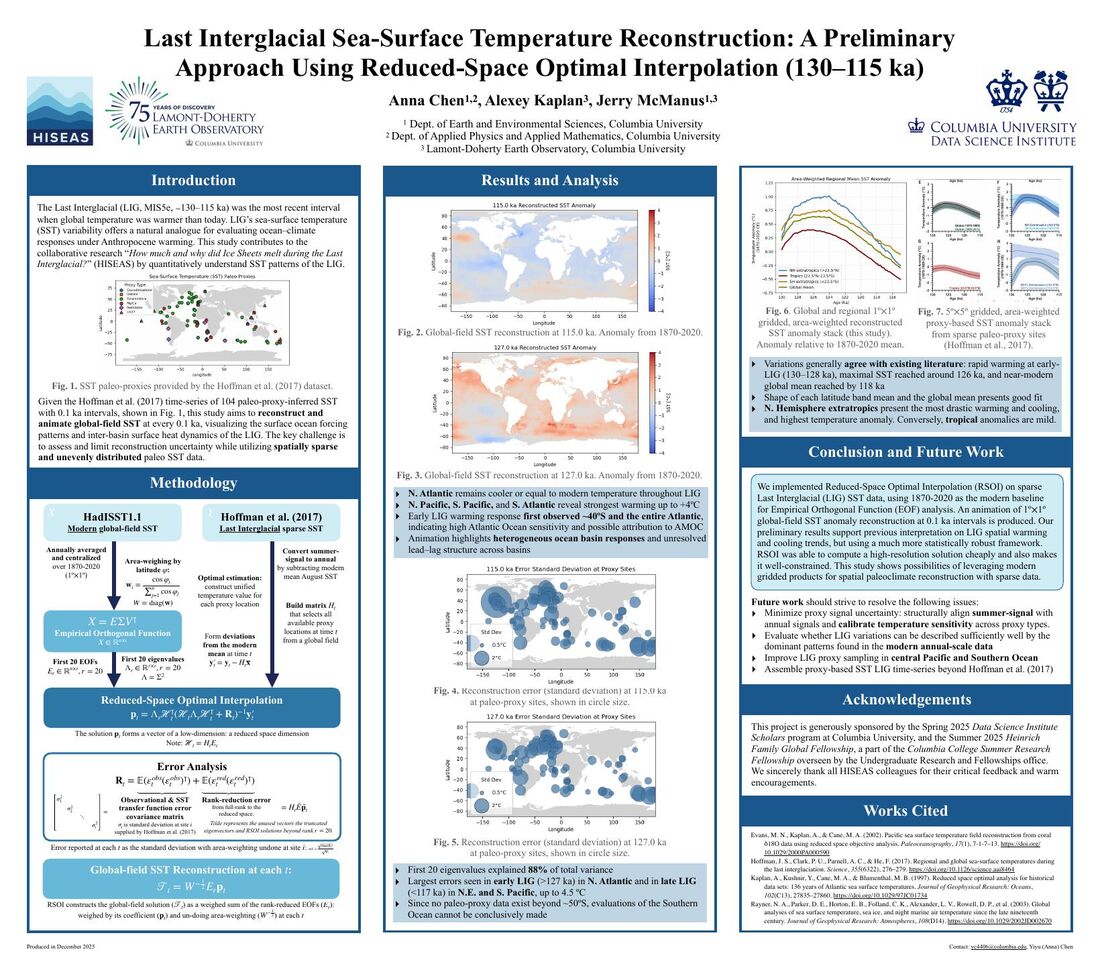
The Last Interglacial (130–115 ka) was the most recent interval during which global temperatures were warmer than today. Its sea-surface temperature variability offers a natural analog for how the ocean responds to modern warming. Proxy records of that interval are sparse and unevenly placed, so recovering a global field from them can provide significantly better understanding of the onset and development of this warm interval.

Starting from the 104 temporally interpolated proxy time series compiled by Hoffman et al. (2017), this project produces a global field reconstruction of LIG sea-surface temperature at 1°×1° resolution and 0.1 kyr intervals, complete with grid-wise uncertainty estimates.

My role

I implemented the reconstruction in Python. I performed Empirical Orthogonal Function analysis on modern annual HadISST v1.1 fields (1870–2020), computed Reduced-Space Optimal Interpolation weight vectors in a 20-dimensional reduced space, and iterated the procedure until the SST mean and covariance converged — which happened by the fifth iteration. I propagated both the published proxy uncertainties and the truncation error of the reduced space into grid-wise uncertainties and uncertainty covariances.

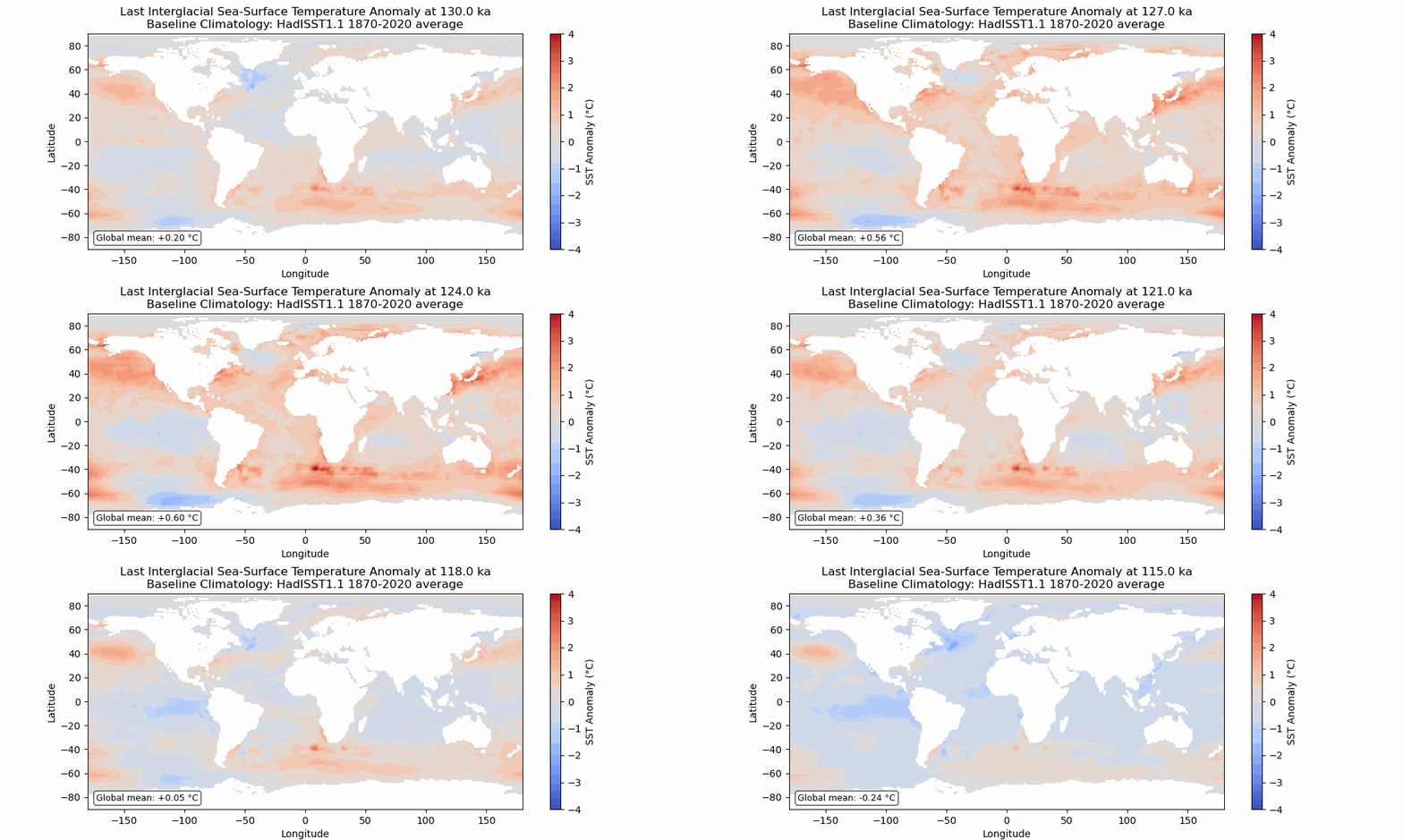
The leading 20 eigenvalues explain 88% of the variance in centennial means. The Northern Hemisphere extratropics show the greatest sensitivity to both warming and cooling, the tropics the lowest anomaly throughout; global mean SST peaks at +0.2 °C above the 1870–2020 mean around 126 ka and returns to near-modern values by 121 ka. To test the reconstruction independently, I mined contributor data files from the NOAA Paleoclimatology database and recovered 62 proxy-based LIG SST records absent from the Hoffman compilation. That validation is ongoing.

Animated map of reconstructed Last Interglacial sea-surface temperature anomaly evolving from 130 to 115 thousand years ago
Global-field reconstructed SST anomaly across 130.0–115.0 ka using Reduced-Space Optimal Interpolation from the Hoffman et al. (2017) deep-ocean core thermo-proxy dataset. Baseline climatology: 1870–2020. Animated · click to enlarge

Materials

Read the AGU 2026 abstract

The Last Interglacial (LIG, 130-115 ka) was the most recent interval during which global temperatures were warmer than today. LIG sea surface temperature (SST) variability offers a natural analog for evaluating ocean-climate responses under ongoing warming. Utilizing the best-current proxy-based dataset of 104 temporally interpolated timeseries over 130-115 ka from Hoffman et al. (2017), we provide a preliminary global field reconstruction of LIG SST at 0.1 kyr intervals and 1-by-1-degree horizontal resolution using Reduced-Space Optimal Interpolation (RSOI). We perform Empirical Orthogonal Function (EOF) analysis on annual modern SST fields from the HadISST v1.1 dataset (1870-2020). Treating the Hoffman et al. dataset as independent observations, weight vectors are computed by RSOI from a 20-dimensional “reduced” space, so that the full field SST is reconstructed as a weighted sum of the 20 leading EOFs. The estimated grid wise uncertainties and uncertainty covariances are calculated from the proxy uncertainties provided by Hoffman et al. and the truncation error of full dimensional SST to the reduced space. By iterating the RSOI procedure, the mean and covariance of the SST field converged by the 5th iteration. In the resulting reconstruction, the first 20 eigenvalues explain 88% of the total variance in centennial means. The spatio-temporal evolution of the reconstructed SST generally matches published literature. The Northern Hemisphere extratropics show the greatest sensitivity to both warming and cooling. The tropics have the lowest SST anomaly throughout the LIG. Maximal global mean SST of +0.2 deg C from the 1870-2020 mean is reached around 126 ka, and near-modern global mean SST is reached by 121 ka. Overall, the RSOI method provided a computationally efficient, well-constrained, and high-resolution solution, complete with its uncertainty estimates. For the planned further assessment of reconstruction’s fidelity, we mined the contributor data files from the NOAA Paleoclimatology database, resulting in finding 62 records of proxy-based LIG SST estimates that are independent of the Hoffman et al. compilation.

AGU 2026 Annual Meeting, San Francisco · Session PP008 — Late Quaternary Climate and Environmental Change: Proxies, Processes, and Models.
Anna Chen, Alexey Kaplan, Jerry F. McManus.

Preliminary data products
Gridded SST, SST anomaly, and standard deviation — 1°×1° at 100-year intervals across 130–115 ka.

Conference poster on Last Interglacial sea-surface temperature reconstruction

Poster — LDEO Geochemistry Poster Session, Fall 2025. Click to enlarge · Download PDF

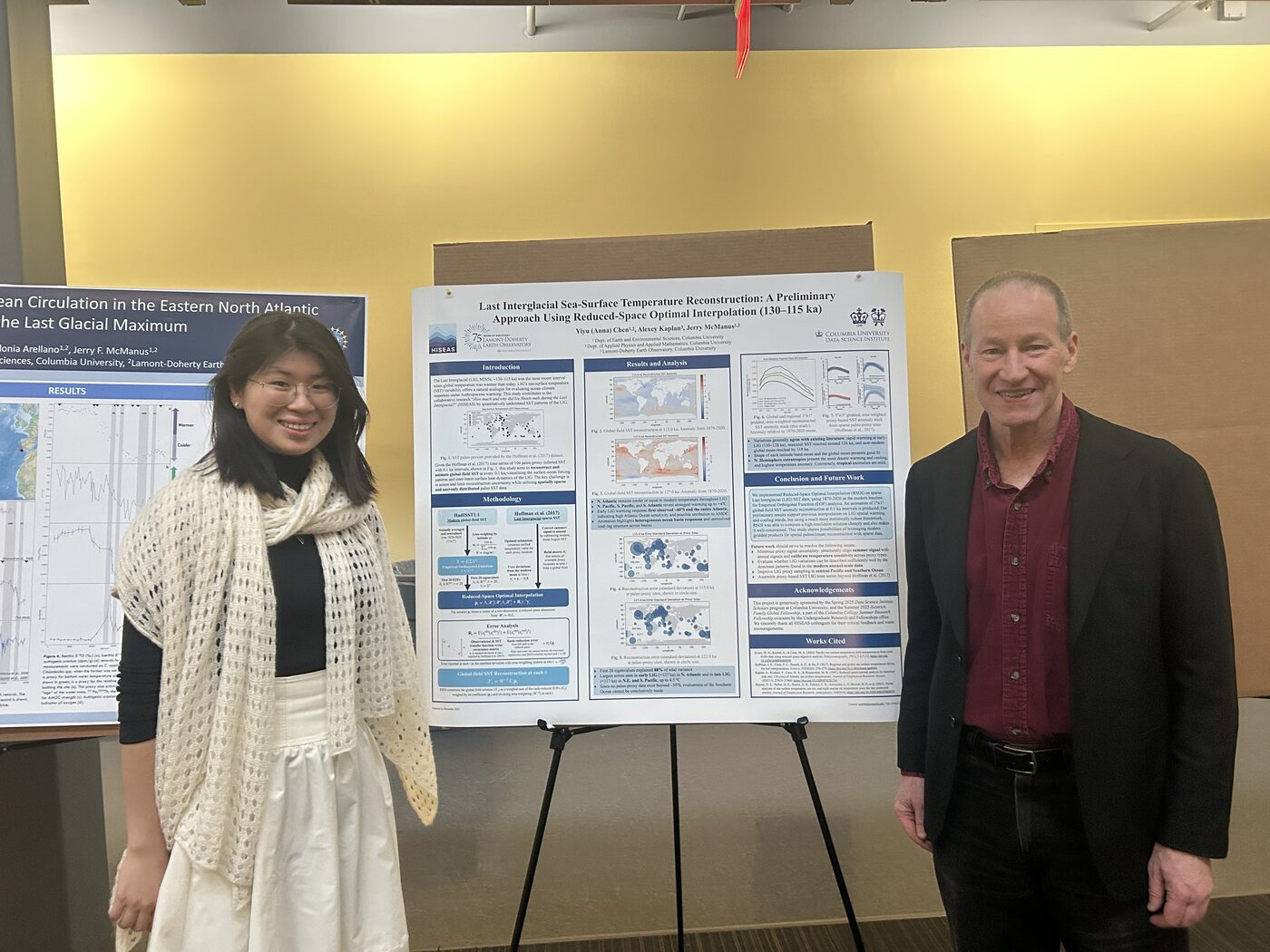
Anna Chen presenting her Last Interglacial poster with Prof. Jerry McManus

Presenting the reconstruction at LDEO with Prof. Jerry McManus.

Also presented at

  • Data Science Institute Scholars Poster Presentation, Columbia University, Spring 2025 (poster)
03

Seasonal and Geospatial Analysis on Geochemical Ocean Conditions in Areas with High Marine Phytoplankton Productivity

Lab · Hurley Lab, LDEO Project · Carbon Fixation in Future Oceans (NSF-funded) PI & Mentor · Sarah J. Hurley Mentor · Henry C. Holm Summer 2024 – Spring 2025
Complete Co-authored manuscript in preparation Laidlaw Scholarship R Wet lab

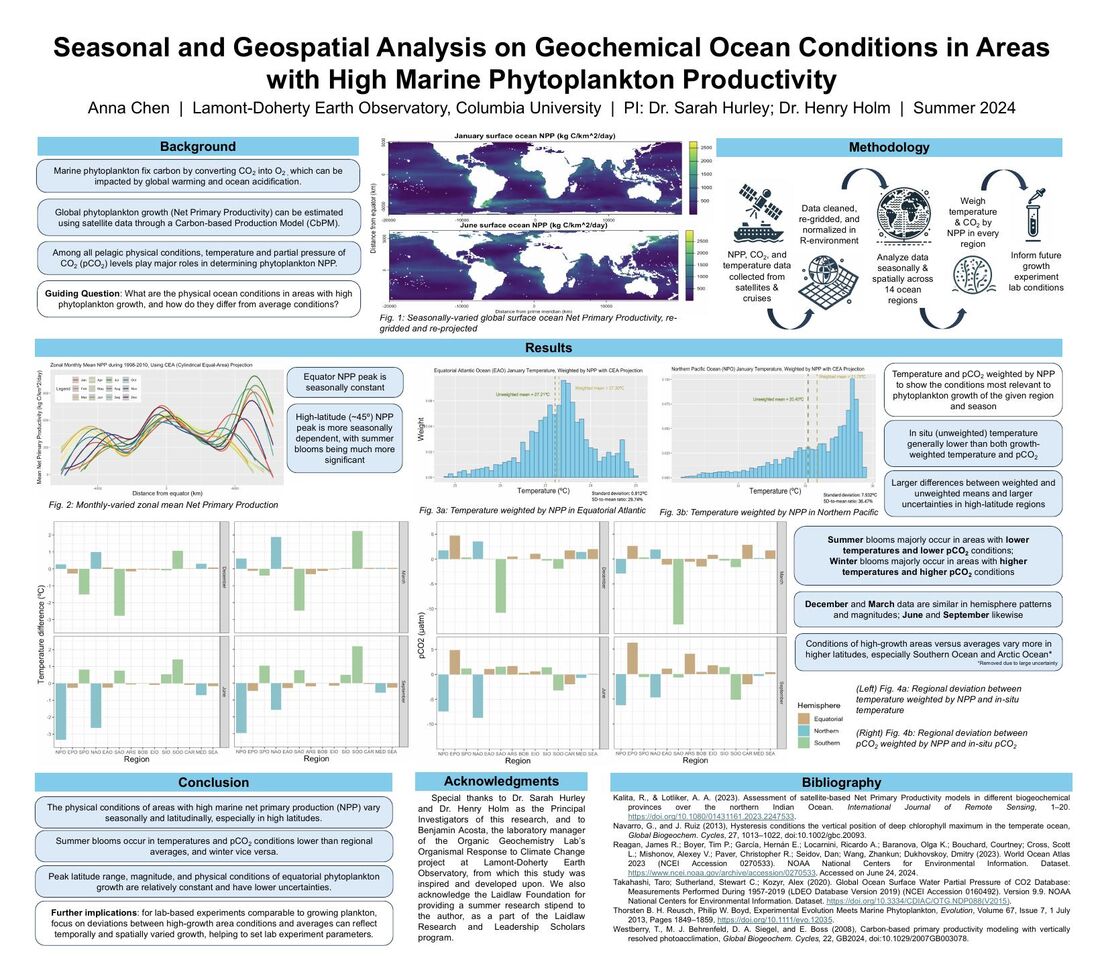
Carbon fixation by marine phytoplankton shapes the global carbon cycle, and climate change will alter it — but the magnitude and direction of that change are poorly constrained. Because phytoplankton adapt readily, lab experiments that aim to predict future growth need accurate present and future conditions to grow them in.

This project constrains the temporal and spatial variability of two physical controls: temperature and pCO2, specifically in the places where net primary production is highest — which turn out different from the regional averages.

My role

I carried out the full analysis in R. I combined satellite net primary production (NPP) with SST and pCO2 1°×1° datasets, re-gridded and area-weighted the three sources, then computed regional means and NPP-weighted geochemical parameters to measure how the water where blooms actually occur deviates from its regional average, and how this differs seasonally.

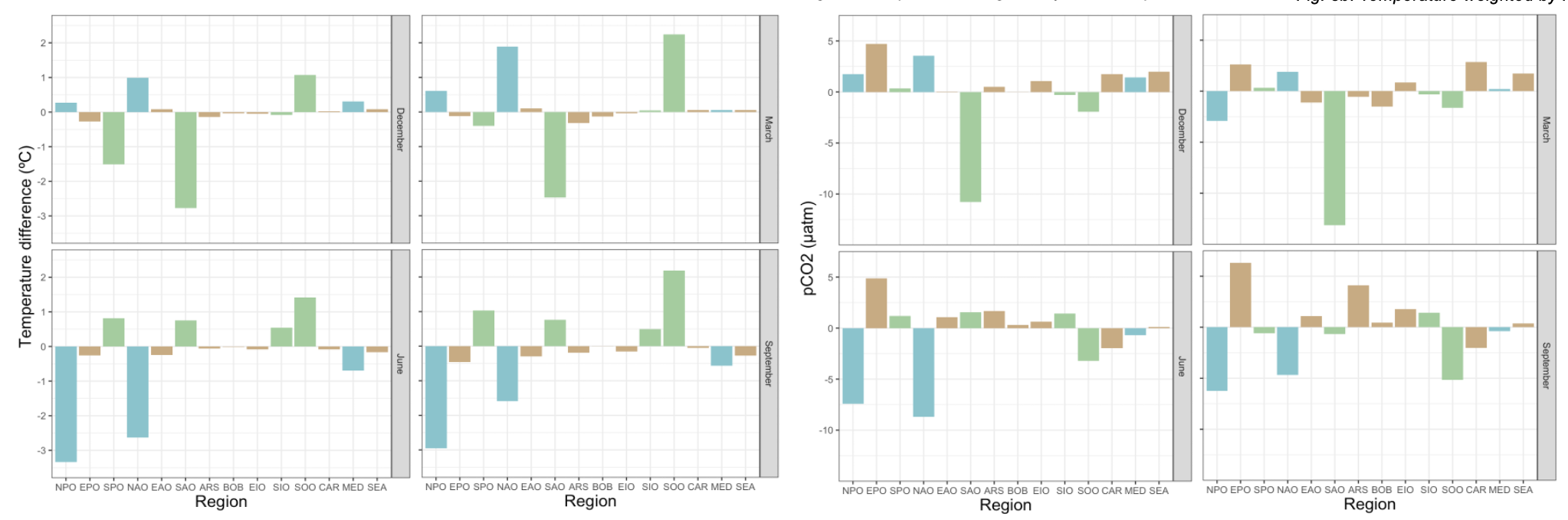
Across 14 ocean regions, and with the exception of the Southern Ocean, summer blooms occur in water that is cooler and lower in pCO2 than the regional mean, while winter growth occurs in warmer, higher-pCO2 water. The practical conclusion for experimentalists is that growth conditions should be set from the deviation of in-situ conditions in high-growth areas, not from seasonal and regional averages. Alongside the analysis, I trained in laboratory practices, including phytoplankton culturing, flow cytometry, media making, and sterile techniques.

Bar charts of regional deviation between NPP-weighted and in-situ sea surface temperature and pCO2, by month
(Left) Regional deviation between sea-surface temperature weighted by net primary production (NPP) and in-situ temperature. (Right) Regional deviation between pCO2 weighted by NPP and in-situ pCO2. Satellite-based NPP data are retrieved from the Carbon-based Production Model; surface ocean temperature from the World Ocean Atlas; and pCO2 from the Global Ocean Surface Water pCO2 Database. Horizontal resolution is 1°×1°. Click to enlarge

Materials

Read the project abstract

Carbon fixation by marine phytoplankton is crucial in influencing the pelagic and global carbon cycle. Future climatic changes likely affect phytoplankton growth and the net primary production (NPP) of surface ocean. However, the magnitude and directionality of growth changes are poorly constrained. Since phytoplankton are highly adaptable, understanding future growth in lab-based experimentation requires accurate current and future conditions. Hence, this study seeks to constrain the temporal and spatial variability of two important physical factors (temperature, CO2) in areas of high NPP. Historical ocean conditions were examined by combining observational data and modeled products. For growth estimates, the author utilized satellite data from the Carbon-based Production Model, a monthly and global estimate of marine NPP at 1/6º-by-1/6º grids. Surface ocean temperature was provided by the World Ocean Atlas, and the partial pressure of CO2 (pCO2) from the Global Ocean Surface Water pCO2 Database. The author calculated regional means and weighted conditions by NPP to evaluate how marine conditions with high NPP deviated from regional averages. Results across 14 regions show that, apart from the Southern Ocean, summer phytoplankton blooms mostly occur in areas with lower temperatures and lower pCO2 conditions relative to regional averages. Opposingly, winter phytoplankton growth occurs in areas with higher temperatures and pCO2. These findings provide insights for lab-based experiments. Rather than viewing growth uniformly across time and space, researchers should focus on the deviation of in-situ conditions in high-growth areas from their seasonal and regional averages to reflect temporally- and spatially-varied growth, outlining more accurate climatological contexts for future lab-based experimentation.

Mentors: Dr. Sarah Hurley, Dr. Henry Holm. Laidlaw Undergraduate Research and Leadership Scholarship, Summer 2024.

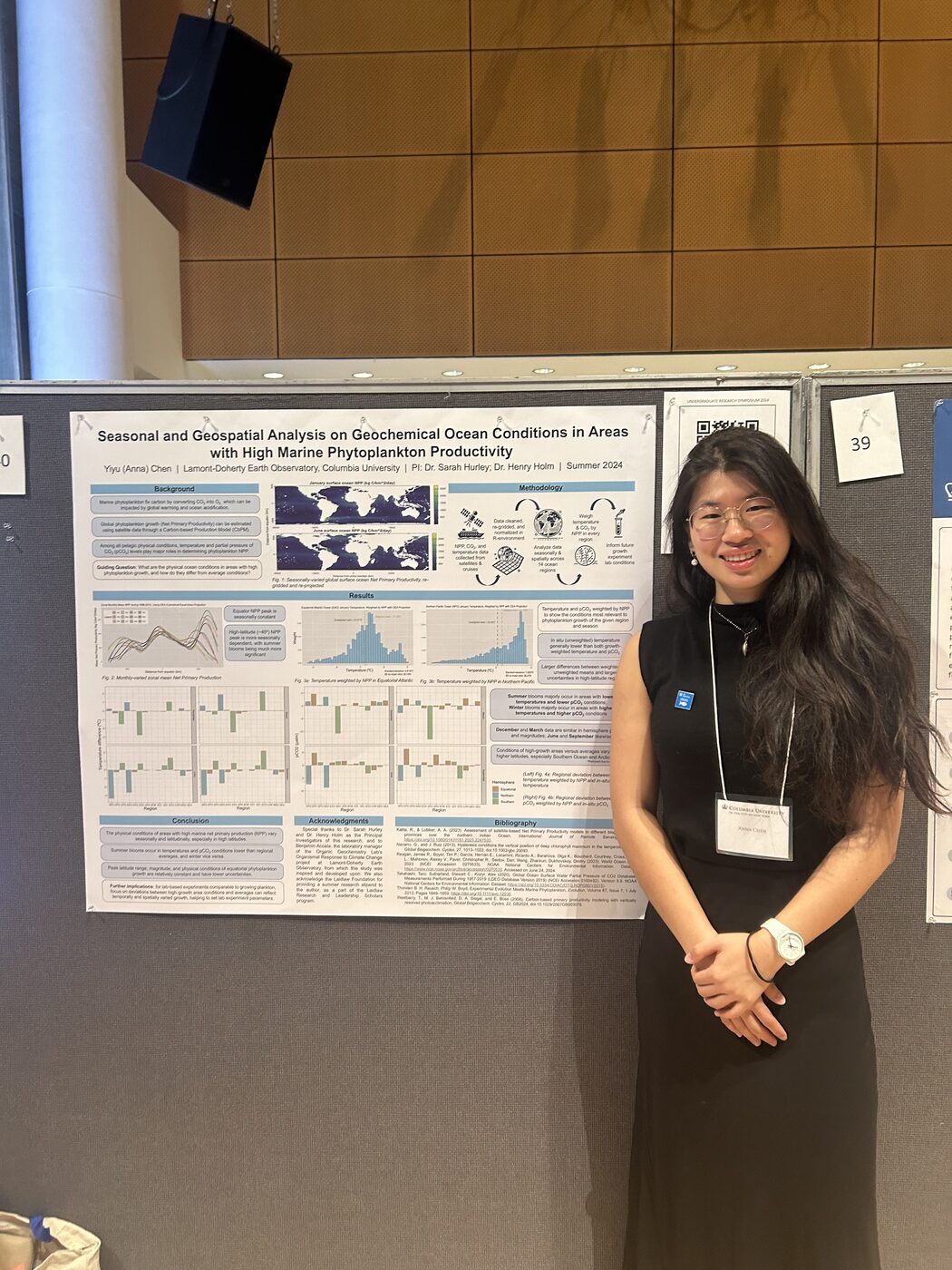
Conference poster on geochemical ocean conditions in areas of high phytoplankton productivity

Poster — presented at LDEO and Columbia, 2024–2025. Click to enlarge · Download PDF

Anna Chen presenting her phytoplankton productivity poster

Presented at

  • LDEO 75th Anniversary Mini Symposium, Fall 2024
  • Undergraduate Computer and Data Science Research Fair, Columbia DSI, Fall 2024
  • Undergraduate Research Symposium, Columbia University, Fall 2024
  • North America Laidlaw Scholars Conference, Columbia University, Fall 2024 (panel/talk)