Anna Chen陈一语
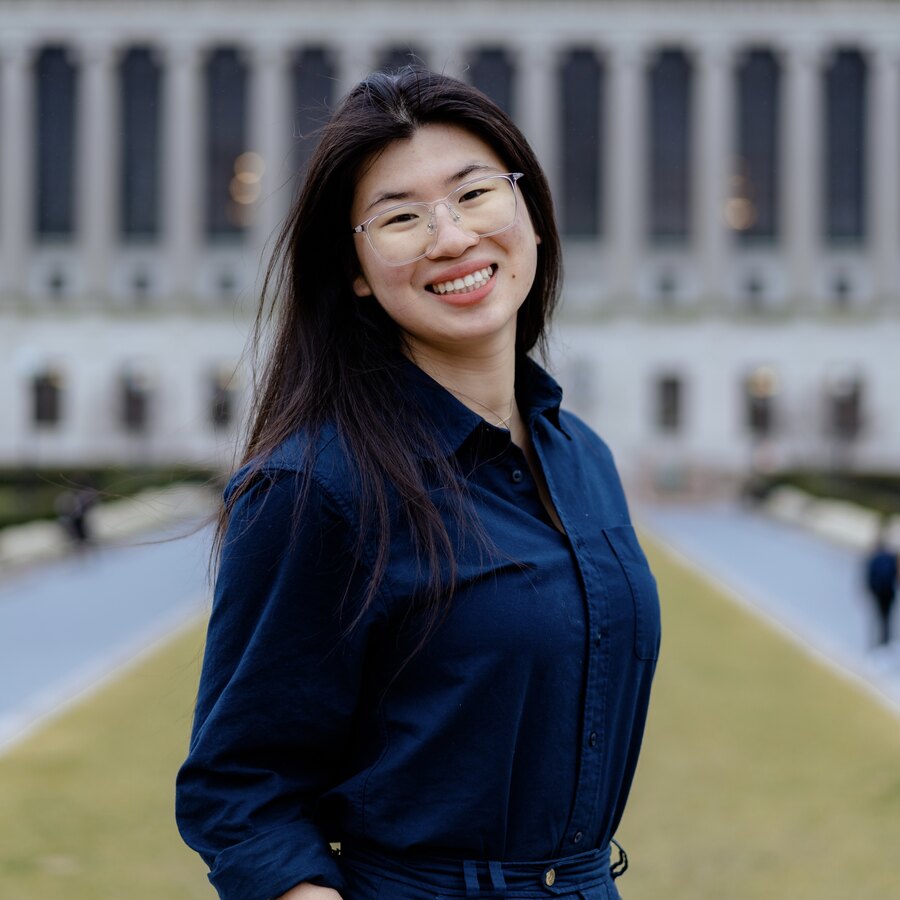
I am a senior at Columbia University, double-majoring in Climate System Science and Applied Mathematics. Currently, I work in two distinct geochemistry labs at the Lamont-Doherty Earth Observatory, mentored by Prof. Galen McKinley and Prof. Jerry McManus, respectively.
I am applying to PhD programs in computational ocean biogeochemistry for Fall 2027 enrollment, with broad interests across marine microbial processes, transport and mixing, ocean acidification, and more.
AI statement: The design of this webpage is coded by Claude (Opus 5), with texts, figures, documents, and photos supplied by AC.
New York, NY · Expected B.A. May 2027
Modeling Ocean Biogeochemistry, Carbon, and Temperature
My research centers on modeling the ocean carbon and biogeochemical cycles. I am most interested in understanding and improving hindcast and forecast models, particularly disentangling impacts from internal variability from that of model structure; in resolving regional-scale biogeochemical fluxes with tractable statistical and algebraic methods; and in understanding how sparse and uneven observational coverage propagates into our model estimates.
For my PhD work, I want to utilize the full range of available data — Argo floats, satellite retrievals, and ship-track and bottle measurements — and to characterize the distinct uncertainties each source carries. The Arctic and the Southern Ocean draw my curiosity most, since both remain sparsely observed and biogeochemically complex. Having also worked in paleoceanographic reconstruction, I would like to potentially bring state-of-the-art modeling methods to bear on constraining uncertainty in the paleo ocean as well.
1 — Surface ocean pCO2 sets the air–sea carbon flux, and observation-based statistical reconstructions of it are validated against model testbeds (McKinley Lab). 2 — Phytoplankton in the euphotic zone fix carbon; the temperature and pCO2 conditions where they grow determine how much (Hurley Lab). 3 — Temperature proxies preserved in seafloor sediment record how the surface ocean behaved during past warm intervals (McManus Lab).
What I work with
Programming
- Python
- R
- LaTeX
- Markdown
Methods
- Reduced-Space Optimal Interpolation
- Empirical Orthogonal Function (EOF) analysis
- Multi-model ensemble benchmarking
- Uncertainty propagation
- Data mining
- Numerical methods
- Differential Equations (ODEs)
Datasets
- CMIP6 Earth System Models
- Global Ocean Biogeochemical Models (GOBMs)
- SOCAT, GLODAP, LDEO pCO2 datasets
- Hadley Centre Sea Ice and Sea Surface Temperature (HadISST) dataset
- World Ocean Atlas (WOA)
- SeaWiFS satellite-derived Carbon-based Production Model
- NOAA Paleoclimatology database
Laboratory
- Phytoplankton culturing
- Flow cytometry
- Media preparation
- Sterile technique
Languages
- Chinese — native
- English — fluent
- German — elementary
I am a U.S. Permanent Resident (Green Card holder). I require no visa sponsorship and am authorized to work and study in the United States.